
LIET
Engineering Chemistry Lab Manual

Institute Vision
To emerge as an Institute of academic excellence by empowering young minds through problem-solving skills, knowledge & ethical values and transforming them into professionals of global competence.
Institute Mission - IM: 1
To create a conducive environment for teaching and learning through continuous engagement with industry for corporate understanding and professionalism.
IM: 2
To equip the students with state-of-the-art technological advancement and skills.
IM: 3
To focus on holistic development of students through enhanced learning along with moral and ethical value system.
Significance of Chemistry
Chemistry plays a crucial role in our daily lives and in solving global challenges. It is the central science that connects physics, biology, and environmental science, enabling progress across multiple fields.
- Health and Medicine: Development of life-saving drugs, vaccines, and diagnostic tools.
- Environment: Pollution control, water purification, and sustainable energy solutions.
- Agriculture: Fertilizers, pesticides, and soil testing for better crop yields.
- Materials: Creation of plastics, ceramics, metals, and nanomaterials used in everyday products.
- Food: Preservatives, flavorings, and nutritional content analysis for safer, better food.
- Clean Energy: Development of batteries, solar panels, and fuel cells for a sustainable future.
In essence: Chemistry helps us understand the world at a molecular level and empowers innovation that benefits society, the economy, and the planet.

Experiment 5
Determination of Surface Tension using Drop Number Method
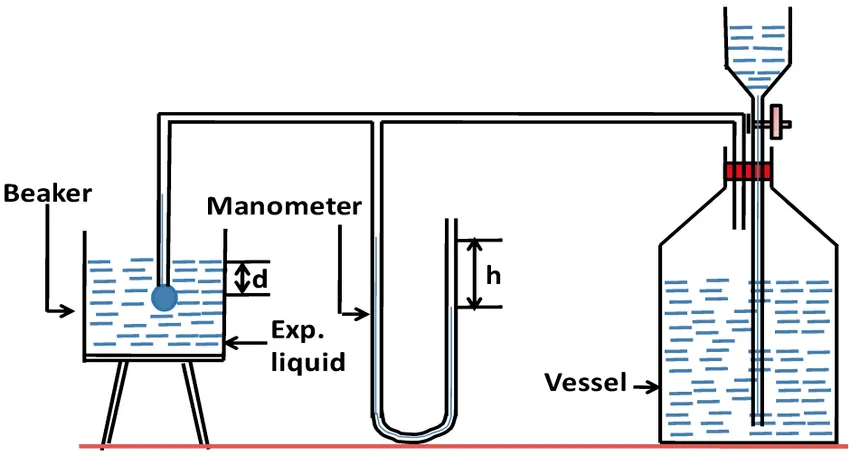
Flow chart
- Fill Pipette: Fill pipette with distilled water using a beaker.
- Count Water Drops: Count the number of drops (n₁) from pipette tip.
- Refill with Test Liquid: Replace water with test liquid in the same pipette.
- Count Test Liquid Drops: Count the number of drops (n₂) from test liquid.
Before Titration
- Clean and dry the dropper/pipette.
- Fill with distilled water.
- Set up the drop counting apparatus.
- Maintain a constant temperature environment.
During Titration
- Count number of drops (n₁) for a fixed volume (e.g., 10 ml) of water.
- Replace water with test liquid.
- Count number of drops (n₂) for the same volume.
- Repeat the experiment for accuracy.
End of Experiment:
Use formula: γ₂ = γ₁ × (n₁ / n₂) × (d₂ / d₁)
Where:
- γ = Surface tension
- d = Density
- n = Number of drops counted
- Result: Surface tension of the given liquid is calculated using the above formula.
Result
Surface tension of the given liquid is calculated using the above formula.
Aim
To determine the surface tension of a given liquid by the drop number method.
Requirements
- Stalagmometer
- Water
- Liquid sample
- Beaker
Theory:
Surface tension is the force per unit length acting along the surface of a liquid, measured in dynes/cm (CGS) or N/m (SI). When a liquid is allowed to drip slowly from a stalagmometer, the number of drops formed is inversely proportional to its surface tension. The surface tension of the given liquid is calculated using the formula:
γ₂ = (n₁ × ρ₁ × γ₁) / (n₂ × ρ₂)
Where:
γ₁ = Surface tension of water
γ₂ = Surface tension of the liquid
n₁ = Number of drops of water
n₂ = Number of drops of liquid
ρ₁ = Density of water
ρ₂ = Density of the liquid
Procedure:
- Clean the stalagmometer with chromic acid.
- Immerse its lower end in distilled water and suck up water to mark A.
- Let the water flow out and count drops between marks A and B.
- Repeat to obtain three readings.
- Clean and dry the stalagmometer, then fill it with the test liquid.
- Let it flow out and count the drops.
- Weigh empty specific gravity bottle (W₁).
- Fill with water, weigh (W₂).
- Empty, dry, fill with test liquid, and weigh again (W₃).
Observation Table
| Trial | No. of Drops (Water) | No. of Drops (Liquid) |
|---|---|---|
| 1 | 56 | 65 |
| 2 | 56 | 65 |
| 3 | 56 | 65 |
| Mean | 56 | 65 |
Calculations
- W₁ (Empty bottle) = 5.5 g
- W₂ (Bottle + Water) = 23.3 g → Weight of water = 17.8 g
- W₃ (Bottle + Liquid) = 24.4 g → Weight of liquid = 18.9 g
- Relative density = (W₃ – W₁) / (W₂ – W₁) = 18.9 / 17.8
- γwater = 72.14 dyne/cm
- γliquid = (18.9 × 56 × 72.14) / (17.8 × 65) = 65.9922 dyne/cm
Result
- The surface tension of the given liquid solution = 65.9922 dyne/cm
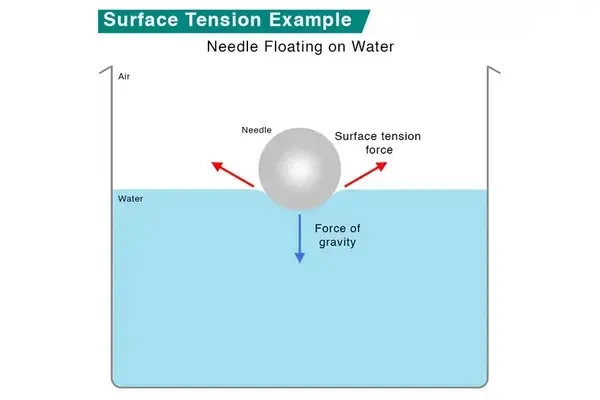
What is Surface Tension?
Surface tension is the cohesive force between liquid molecules at the surface. It’s responsible for phenomena like water droplets forming beads and insects walking on water.
Sustainability Connections:
Surface tension changes indicate presence of pollutants, helping monitor clean water initiatives.
Aids development of biodegradable soaps and surfactants with minimal environmental harm.
Understanding surface behavior helps optimize processes like painting and coating, lowering waste.
Surface tension helps create sustainable nano-solutions for medicine and agriculture.
Used in the formulation of eco-friendly dispersants and cleanup agents.
Conclusion
The surface tension experiment supports sustainability by enabling cleaner industrial processes, improving environmental monitoring, and fostering eco-innovation.
Experiment 6
Determination of PH by ph metric titration
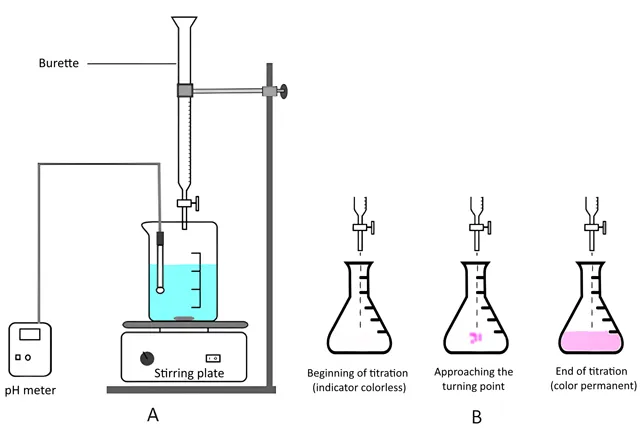
Flow Chart
Before Titration
- Calibrate pH meter using standard buffer solutions (pH 4, 7, 9).
- Take 50 mL of the acid/base solution in a beaker.
- Insert the pH electrode into the solution.
- Set up burette with titrant (e.g., NaOH).
During Titration
- Add titrant slowly in 1 mL increments.
- Stir and record pH after each addition.
- Observe sharp pH change near equivalence point.
- Plot pH vs volume added.
End Of Titration
- Identify equivalence point from the graph.
- Determine nature of acid/base from pH data.
Aim
To determine the pH of a given solution and identify the equivalence point using pH-metric titration.
Requirements:
- pH meter
- Beaker and burette
- Magnetic stirrer (optional)
- Standard NaOH solution (or acid depending on titration type)
- Unknown acidic or basic solution
- Distilled water
Theory:
pH-metric titration is a method of determining the endpoint of a titration using a pH meter. As the titrant is added, the pH of the solution changes. The point at which there is a sudden change in pH corresponds to the equivalence point.
The pH is calculated using:
pH = –log[H⁺]
By plotting a graph of pH vs. volume of titrant added, the equivalence point can be determined from the sharp change in the pH curve.
Procedure:
- Calibrate the pH meter using standard buffer solutions.
- Take 50 mL of the acid/base solution in a beaker.
- Insert the electrode of the pH meter into the solution.
- Record the initial pH of the solution.
- Add titrant (e.g., NaOH) slowly from a burette in 1 mL increments.
- After each addition, stir the solution gently and record the new pH.
- Continue the process until you observe a sharp change in pH readings.
Observation Table
| Volume of NaOH added (mL) | pH |
|---|---|
| 0 | 3.2 |
| 1 | 3.8 |
| 2 | 4.5 |
| 3 | 5.4 |
| 4 | 6.2 |
| 5 | 8.3 |
| 6 | 10.2 |
| 7 | 11.5 |
Graph
Plot a graph of pH (Y-axis) vs. volume of NaOH added (X-axis). The equivalence point is where the curve rises steeply.
Result
The pH of the initial solution is 3.2 (acidic).
The equivalence point was observed at approximately 5.5 mL of NaOH, where the pH sharply increased.
Sustainability in Determination of pH by pH-Metric Titration
Reduces need for synthetic indicators, lowering chemical waste output.
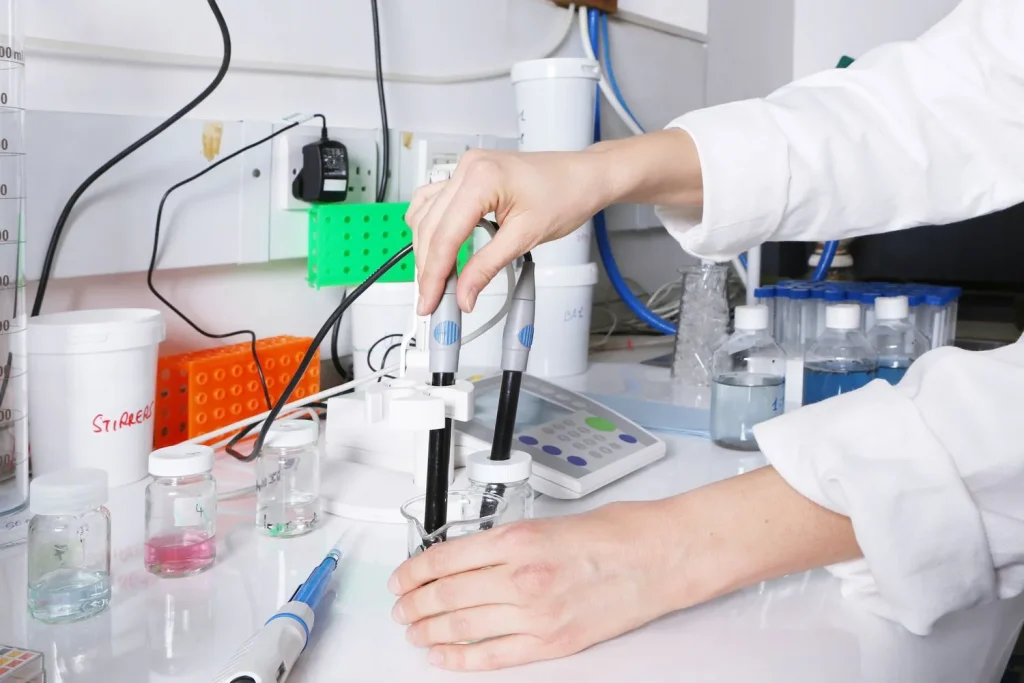
Digital pH meters provide precise endpoints, minimizing repeat testing and saving reagents.
Electronic data storage reduces paper use in lab records.
Low-volume, clear solutions are easier to neutralize and dispose of safely.
Contributes to SDG 6 (Clean Water) and SDG 12 (Responsible Consumption and Production).
