
LIET
Engineering Chemistry Lab Manual

Institute Vision
To emerge as an Institute of academic excellence by empowering young minds through problem-solving skills, knowledge & ethical values and transforming them into professionals of global competence.
Institute Mission - IM: 1
To create a conducive environment for teaching and learning through continuous engagement with industry for corporate understanding and professionalism.
IM: 2
To equip the students with state-of-the-art technological advancement and skills.
IM: 3
To focus on holistic development of students through enhanced learning along with moral and ethical value system.
Significance of Chemistry
Chemistry plays a crucial role in our daily lives and in solving global challenges. It is the central science that connects physics, biology, and environmental science, enabling progress across multiple fields.
- Health and Medicine: Development of life-saving drugs, vaccines, and diagnostic tools.
- Environment: Pollution control, water purification, and sustainable energy solutions.
- Agriculture: Fertilizers, pesticides, and soil testing for better crop yields.
- Materials: Creation of plastics, ceramics, metals, and nanomaterials used in everyday products.
- Food: Preservatives, flavorings, and nutritional content analysis for safer, better food.
- Clean Energy: Development of batteries, solar panels, and fuel cells for a sustainable future.
In essence: Chemistry helps us understand the world at a molecular level and empowers innovation that benefits society, the economy, and the planet.

Experiment 9
Determination of Rate Constant for Hydrolysis of an Ester
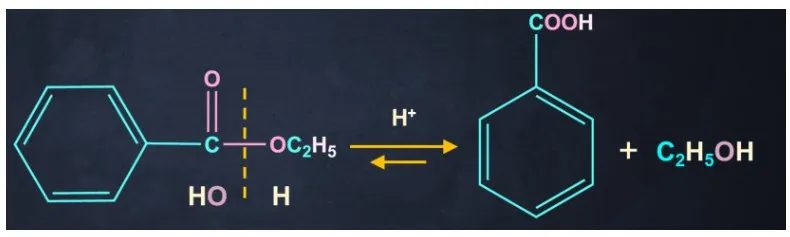
Flow Chart
Before Reaction
- Prepare methyl acetate + dilute HCl solution.
- Place in water bath at constant temperature.
- Start stopwatch.
During Reaction
- At t = 0, withdraw 5 mL and titrate with NaOH (get V₀).
- At intervals (10, 20, 30 min), withdraw 5 mL and titrate (get Vt).
- Continue until volume stabilizes (V∞).
End of Reaction
- Use formula: k = (2.303 / t) × log((V∞ – V₀) / (V∞ – Vt))
- Average values to get rate constant.
Aim
To determine the rate constant (k) for the acid-catalyzed hydrolysis of methyl acetate using titration method.
Requirements
- Methyl acetate (CH₃COOCH₃)
- Hydrochloric acid (HCl)
- Standard NaOH solution
- Phenolphthalein indicator
- Water bath
- Conical flasks, burette, pipette, stopwatch
Theory:
The hydrolysis of ester in acidic medium is a pseudo first-order reaction:
CH₃COOCH₃ + H₂O → CH₃COOH + CH₃OH
The rate constant k is calculated using the first-order integrated rate law:
k = (2.303 / t) × log[(V∞ – V₀) / (V∞ – Vt)]
Where:
V₀ = Volume of NaOH at time 0
Vt = Volume of NaOH after time t
V∞ = Volume at infinite time (reaction completion)
Procedure:
- Mix equal volumes of methyl acetate and HCl in a flask and place in a constant-temperature water bath.
- At time zero, withdraw 5 mL and titrate with standard NaOH using phenolphthalein (record V₀).
- At regular intervals (e.g., every 10 minutes), withdraw 5 mL samples and titrate with NaOH to get Vt.
- Continue until constant volume is observed (V∞).
- Calculate k using the formula for each time point and take the average.
Observation Table
| Time (min) | Volume of NaOH used (Vt) in mL | log[(V∞ – V₀)/(V∞ – Vt)] | k (min⁻¹) |
|---|---|---|---|
| 0 | 10.5 | -- | -- |
| 10 | 14.2 | 0.1761 | 0.0406 |
| 20 | 16.8 | 0.3010 | 0.0347 |
| 30 | 18.4 | 0.3979 | 0.0306 |
Result
The average rate constant (k) for the hydrolysis of methyl acetate is approximately 0.0353 min⁻¹.
Sustainability in Determination of Rate Constant of Ester Hydrolysis
Uses low-toxicity reagents in small amounts, producing minimal chemical waste.
Products like acetic acid and methanol are less hazardous and biodegradable.
Conducted at room or mildly elevated temperatures using simple lab equipment.
Builds foundational knowledge of kinetics, helping future chemists design more sustainable reactions.
Encourages mindful lab practices under SDG 12 – Responsible Consumption and Production.
Experiment 10
Determination of Cell Constant and Conductance of a Solution
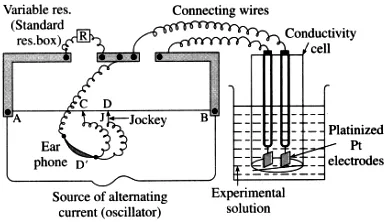
Flow Chart
Before Measurement
- Wash conductivity cell thoroughly.
- Fill with 0.01 N KCl solution.
- Stabilize temperature at 25°C.
During Measurement
- Measure conductance (G₁) of KCl solution.
- Calculate cell constant: G* = κ / G₁.
- Rinse and fill cell with unknown solution.
- Measure conductance (G₂).
End of Experiment
- Calculate conductivity: κ = G₂ × G*.
- Record and interpret the result.
Aim
To determine the cell constant of a conductivity cell using standard KCl solution, and to find the conductance of an unknown solution.
Requirements:
- Conductivity bridge or conductivity meter
- Conductivity cell
- Standard KCl solution (0.01 N or 0.1 N)
- Unknown solution (e.g., acid, base, or salt)
- Beakers, wash bottle, distilled water
Theory:
The cell constant (G\*) is a factor that relates the measured conductance (G) to the actual conductivity (κ) of the solution:
G\* = κ / G
Once the cell constant is known using a standard KCl solution (whose conductivity κ is known), it can be used to determine the conductivity of unknown solutions using:
κ = G × G\*
Where:
G = 1 / R = Conductance in S (Siemens)
κ = Specific Conductivity (S·cm⁻¹)
G\* = Cell constant (cm⁻¹)
Procedure:
- Wash the conductivity cell with distilled water and then with standard KCl solution.
- Fill the conductivity cell with standard KCl solution and measure conductance (G₁).
- Calculate the cell constant: G\* = κ / G₁ (κ for 0.01 N KCl at 25°C = 0.00141 S·cm⁻¹).
- Rinse the cell and fill with the unknown solution.
- Measure conductance (G₂) of the unknown solution.
- Calculate its specific conductivity using: κ = G₂ × G\*
Observation Table
| Solution | Observed Conductance (G) (S) | Known/Calculated κ (S·cm⁻¹) | Cell Constant (G\*) |
|---|---|---|---|
| Standard KCl (0.01 N) | 0.630 | 0.00141 | 0.00224 cm⁻¹ |
| Unknown solution | 0.450 | ---- | ---- |
Calculations
- Cell constant G\* = κ / G = 0.00141 / 0.630 = 0.00224 cm⁻¹
- Conductivity of unknown = G × G\* = 0.450 × 0.00224 = 0.001008 S·cm⁻¹
Result
- The specific conductivity of the unknown solution is 0.001008 S·cm⁻¹.
Sustainability in Determination of Cell Constant and Conductance
Requires only dilute solutions and small sample volumes, reducing waste generation.
Conductivity cells and electrodes can be cleaned and reused multiple times, lowering lab resource consumption.
No toxic or hazardous byproducts are formed, making the experiment safe for students and the environment.
Helps in efficient chemical dosing in water treatment, supporting eco-conscious operations.
Promotes SDG 6 (Clean Water and Sanitation) and SDG 12 (Responsible Consumption and Production).
ABOUT US
See here to know more about our college and us: https://liet.in/
