
LIET
Engineering Chemistry Lab Manual
Institute Vision
To emerge as an Institute of academic excellence by empowering young minds through problem-solving skills, knowledge & ethical values and transforming them into professionals of global competence.
Institute Mission - IM: 1
To create a conducive environment for teaching and learning through continuous engagement with industry for corporate understanding and professionalism.
IM: 2
To equip the students with state-of-the-art technological advancement and skills.
IM: 3
To focus on holistic development of students through enhanced learning along with moral and ethical value system.
Significance of Chemistry
Chemistry plays a crucial role in our daily lives and in solving global challenges. It is the central science that connects physics, biology, and environmental science, enabling progress across multiple fields.
- Health and Medicine: Development of life-saving drugs, vaccines, and diagnostic tools.
- Environment: Pollution control, water purification, and sustainable energy solutions.
- Agriculture: Fertilizers, pesticides, and soil testing for better crop yields.
- Materials: Creation of plastics, ceramics, metals, and nanomaterials used in everyday products.
- Food: Preservatives, flavorings, and nutritional content analysis for safer, better food.
- Clean Energy: Development of batteries, solar panels, and fuel cells for a sustainable future.
In essence: Chemistry helps us understand the world at a molecular level and empowers innovation that benefits society, the economy, and the planet.
Experiment 7
Determination of Available Chlorine in Bleaching Powder
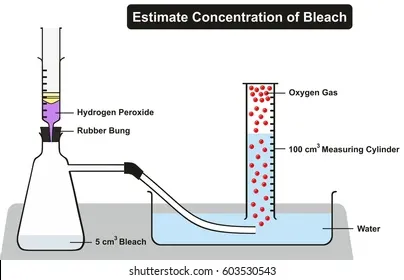
Flow Chart
Before Titration
- Weigh ~1 g bleaching powder and dissolve in 250 mL distilled water.
- Pipette 25 mL of solution into conical flask.
- Add potassium iodide and acetic acid.
During Titration
- Liberated I₂ gives brown color.
- Titrate with N/10 Na₂S₂O₃ until pale yellow.
- Add starch → solution turns blue.
- Continue until blue color disappears.
End of Experiment:
- Note burette reading.
- Repeat to get concordant values.
- Calculate % chlorine using formula.
Aim
To determine the percentage of available chlorine in the given sample of bleaching powder.
Requirements
- Bleaching powder sample
- Standard sodium thiosulphate solution (N/10)
- Potassium iodide (KI) solution
- Glacial acetic acid or dilute acetic acid
- Starch indicator
- Distilled water, burette, pipette, conical flask, beakers
Theory
Bleaching powder contains calcium hypochlorite, which reacts with potassium iodide in acidic medium to liberate iodine (I₂). The liberated iodine is titrated with sodium thiosulphate.
Reactions:
Ca(OCl)₂ + 4KI + 2CH₃COOH → CaCl₂ + 2KCl + 2CH₃COOK + 2H₂O + I₂
I₂ + 2Na₂S₂O₃ → 2NaI + Na₂S₄O₆
Procedure:
- Weigh about 1 g of bleaching powder and dissolve in 250 mL of distilled water. Filter if necessary.
- Pipette out 25 mL of the filtrate into a conical flask.
- Add 10 mL of KI solution and a few drops of acetic acid.
- Allow the solution to stand for 5 minutes in the dark.
- Titrate the liberated iodine with N/10 sodium thiosulphate until the solution becomes pale yellow.
- Add a few drops of starch indicator (solution turns blue-black).
- Continue titration until the blue color just disappears.
- Note the volume of sodium thiosulphate used.
- Repeat for concordant readings.
Observation Table
| Trial | Initial Burette Reading (mL) | Final Burette Reading (mL) | Volume Used (mL) |
|---|---|---|---|
| 1 | 0.0 | 23.0 | 23.0 |
| 2 | 0.0 | 22.8 | 22.8 |
| 3 | 0.0 | 23.0 | 23.0 |
| Average Volume | 22.93 mL | ||
Calculations
- Available chlorine (%) = (V × N × 35.5 × 100) / (1000 × W)
- Where:
V = Volume of sodium thiosulphate used (mL)
N = Normality of sodium thiosulphate
W = Weight of bleaching powder in 25 mL aliquot
35.5 = Equivalent weight of chlorine
Result
- The percentage of available chlorine in the bleaching powder sample is calculated using the above formula.
Sustainability in Determination of Available Chlorine in Bleaching Powder
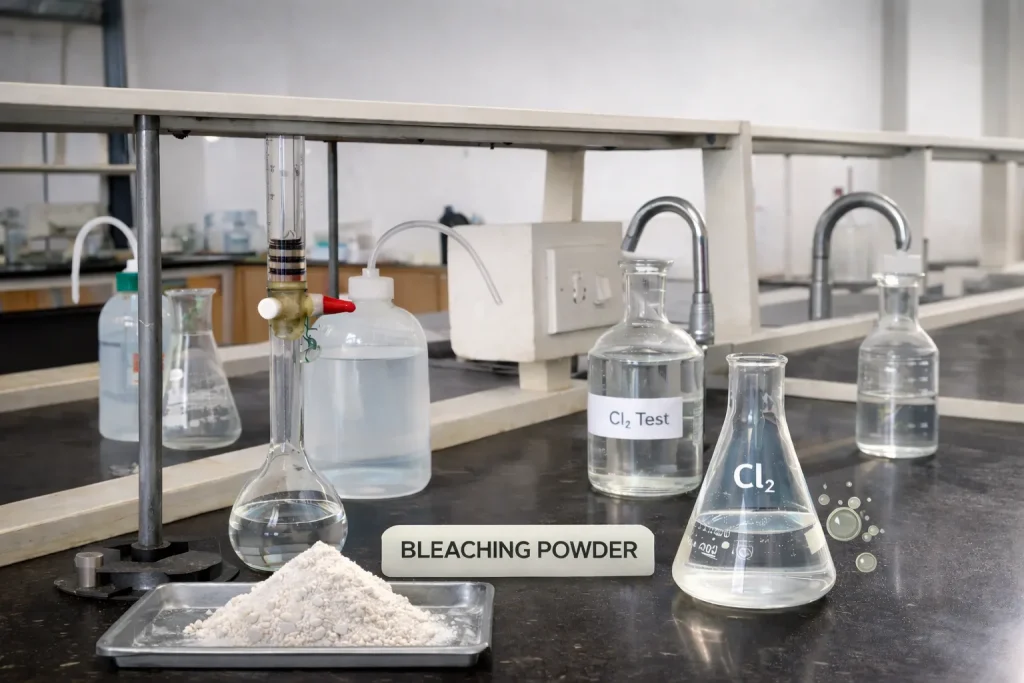
Accurate chlorine measurement ensures effective and safe dosing, protecting ecosystems and human health.
Avoids unnecessary chemical usage and reduces environmental load.
Helps ensure drinking water safety, supporting SDG 6 – Clean Water and Sanitation.
Prevents over-chlorination and formation of toxic byproducts.
Promotes minimal use and safe disposal of reagents (aligned with SDG 12 – Responsible Consumption and Production).
Experiment 8
Verification of Beer’s Law
Flow Chart
Before Measurement
- Prepare standard dye/K₂Cr₂O₇ solutions (0.02–0.10 M).
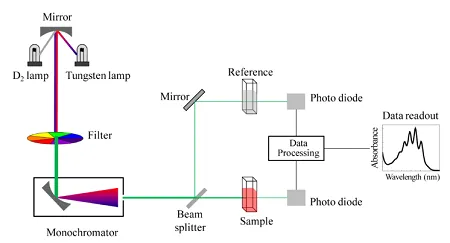
- Set appropriate wavelength on colorimeter.
- Calibrate with blank (distilled water).
During Measurement
- Measure absorbance of each solution.
- Record concentration vs absorbance.
- Repeat for consistent values.
End of Experiment
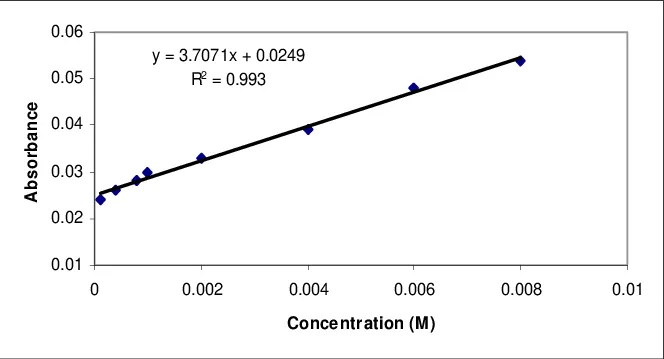
- Plot absorbance vs concentration graph.
- Straight-line graph confirms Beer–Lambert law.
Aim
To verify Beer’s Law by measuring the absorbance of colored solutions of known concentrations using a colorimeter or spectrophotometer.
Requirements:
- Colorimeter or spectrophotometer
- Standard dye or potassium dichromate solution
- Cuvettes
- Volumetric flasks and pipettes
- Distilled water
Theory:
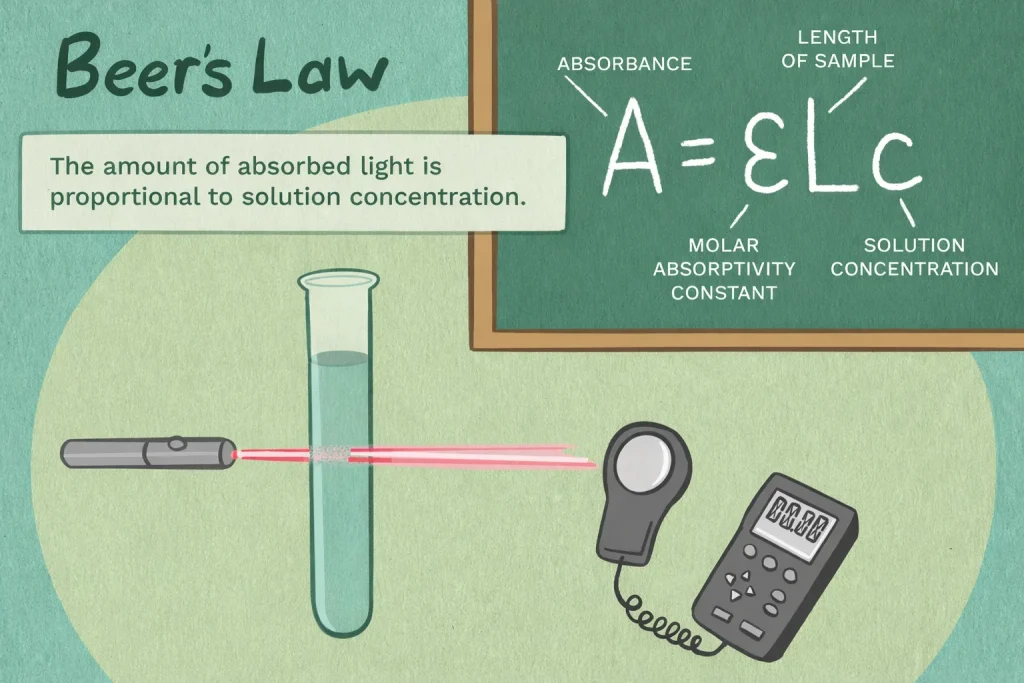
Beer’s Law states that absorbance (A) is directly proportional to concentration (c) for a fixed path length (l) and molar absorptivity (ε):
A = ε × c × l
By plotting absorbance vs. concentration, we should obtain a straight line passing through the origin.
Procedure:
- Prepare a series of standard solutions of known concentrations (e.g., 0.02, 0.04, 0.06, 0.08, 0.10 M).
- Set the colorimeter to the appropriate wavelength for the solution.
- Use distilled water as a blank to calibrate the instrument.
- Measure the absorbance of each standard solution.
- Plot absorbance (Y-axis) against concentration (X-axis).
Observation Table
| Concentration (mol/L) | Absorbance (A) |
|---|---|
| 0.02 | 0.12 |
| 0.04 | 0.25 |
| 0.06 | 0.38 |
| 0.08 | 0.51 |
| 0.10 | 0.64 |
Result
Since the absorbance increases linearly with concentration, Beer’s Law is verified.
Graph
Plot a graph of Absorbance (Y-axis) vs. Concentration (X-axis). A straight line confirms Beer’s Law.
Sustainability in Verification of Beer’s Law
Small volumes of solutions are needed, minimizing chemical consumption and waste.
Spectrophotometry does not alter the sample, allowing safe disposal or reuse.
Analytical precision is achieved without excess reagents.
No toxic or corrosive substances involved, ensuring a safer laboratory environment.
Encourages responsible usage of chemicals and energy in educational and industrial settings.
